CYBERSECURITY THREATS IN THE MODERN DIGITAL WORLD
Cyber threats are evolving rapidly. As technology advances, attackers are becoming smarter, faster, and more organized. Below are the main categories of threats you should be aware of in 2025 and beyond, along with the latest trends shaping the security landscape.
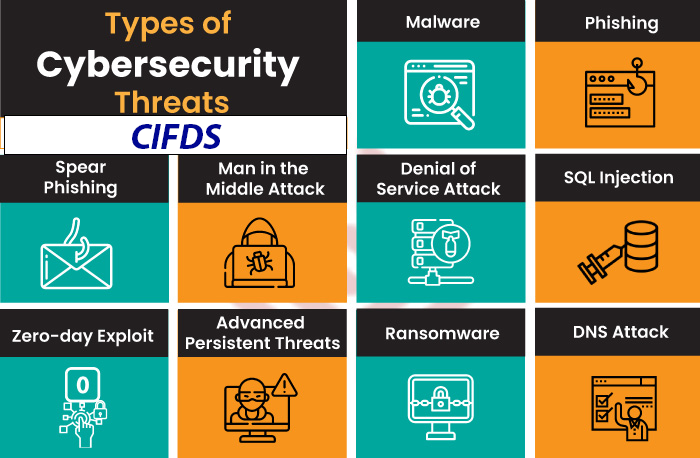
- MALWARE
Malware (malicious software) remains one of the most common threats. It includes:
- Viruses & Worms – Infect and spread through systems, damaging files and functions.
- Ransomware – Locks or encrypts your data, demanding payment to unlock it.
- Spyware & Keyloggers – Secretly track user actions, often stealing passwords and sensitive data.
- Fileless Malware – Runs in memory, leaving no trace on disk, making detection difficult.
- Cryptojacking – Quietly uses your computer’s power to mine cryptocurrency.
AI-enhanced malware is now a major concern. Modern variants use machine learning to evade antivirus, mimic legitimate traffic, and adapt in real time.
2. SOCIAL ENGINEERING
Social engineering attacks target people, not systems. Criminals manipulate trust to get access or information.
Main methods include:
- Phishing – Fake emails or messages tricking users into revealing credentials.
- Spear Phishing – Highly targeted, personalized attacks (e.g., fake HR or IT requests).
- Vishing – Phone scams pretending to be banks or support teams.
- Smishing – SMS scams with malicious links.
- Pretexting & Baiting – Impersonation or tempting offers to get confidential data.
- Business Email Compromise (BEC) – Fake executive emails requesting urgent money transfers.
👉 These attacks work because they exploit human habits. Awareness and verification are your best defenses.
3. AI-POWERED CYBER ATTACKS
Attackers are now using artificial intelligence to supercharge their methods:
- Automating vulnerability scanning and exploitation.
- Crafting convincing phishing emails at scale.
- Generating fake audio and video to impersonate trusted figures.
- Adjusting tactics in real time to bypass defenses.
Traditional defenses are not enough. Organizations must start using AI-based security to fight AI-based attacks.
4. DEEPFAKE THREATS
Deepfake technology uses AI to create realistic fake videos, images, or voices.
- The number of deepfakes shared online jumped from 500,000 in 2023 to an expected 8 million by 2025.
- Attackers use deepfakes to impersonate executives, celebrities, or family members to spread misinformation or commit fraud.
- One recent example involved a fake image of a celebrity endorsing a political candidate, which spread widely before being debunked.
👉 As deepfakes get harder to detect, verification through trusted channels is essential.
5. NETWORK AND APPLICATION ATTACKS
These target the core infrastructure that businesses rely on.
- DDoS (Distributed Denial of Service) – Floods systems with traffic to knock them offline. Multi-vector DDoS attacks are increasing, combining methods to make defense harder.
- Man-in-the-Middle (MitM) – Attackers intercept and alter communications between two parties.
- Injection Attacks (SQL, code, OS commands) – Insert malicious input into software, tricking it into revealing or altering data.
Modern attackers exploit misconfigured cloud environments, outdated TLS settings, or application code vulnerabilities. Web application firewalls, strict input validation, encryption, and zero-trust models are key defenses.
6. DIGITAL INFRASTRUCTURE THREATS
INTERNET OF THINGS (IOT)
Billions of connected devices—smart cameras, appliances, sensors—often lack strong security. Attackers hijack them to form botnets or access internal networks.
SUPPLY CHAIN ATTACKS
Criminals compromise software, hardware, or service providers to attack many organizations at once. These have risen 2600% since 2018, making them one of the most dangerous modern attack types.
CLOUD SECURITY RISKS
Misconfigured cloud storage and weak access controls lead to major data leaks. Companies must use automated tools, least-privilege policies, and regular audits to keep cloud systems secure.
7. ADVANCED PERSISTENT THREATS (APTS)
APTs are long-term, targeted attacks carried out by skilled groups, often linked to nation-states. Their goal is espionage, disruption, or theft.
Characteristics:
- Targeted and strategic.
- Operate for months or years without detection.
- Use multiple tools (phishing, malware, lateral movement) to maintain control.
Defending against APTs requires continuous monitoring, zero-trust architecture, threat intelligence sharing, and rapid incident response.
8. INSIDER AND STATE-SPONSORED THREATS
Insider Threats come from employees or contractors who misuse their access—intentionally or accidentally.
State-Sponsored Attacks involve governments targeting industries like energy, defense, or tech for political or economic advantage.
Defenses include:
- Behavioral monitoring and anomaly detection.
- Least privilege access controls.
- Regular security audits and awareness programs.
9. PRIVACY BREACHES AND DATA EXPOSURE
Data breaches remain a critical issue. Regulations like GDPR and CCPA require companies to secure personal data and report breaches quickly.
High-profile breaches like Equifax and Capital One show the damage caused by:
- Unpatched vulnerabilities
- Misconfigured firewalls
- Poor access control
Companies must adopt continuous monitoring, regular patching, strong encryption, and compliance audits to reduce exposure.
10. WORKFORCE & RESOURCE CHALLENGES
There’s a global shortage of cybersecurity professionals, making it harder to respond to growing threats. Many organizations face budget cuts while threats increase, leaving gaps in defense. Investing in training, automation, and partnerships is essential to fill this gap.
SUMMARY TABLE: TOP CYBERSECURITY THREATS 2025
| Threat Type | Key Tactics | Impact | Key Defenses |
| Malware | Viruses, ransomware, cryptojacking | System damage, data loss, ransom costs | Layered security, updates, monitoring |
| Social Engineering | Phishing, BEC, vishing, pretexting | Credential theft, financial loss | Awareness training, MFA, verification |
| AI Attacks | Automated exploits, adaptive phishing | Harder to detect, faster attacks | AI-driven defense, behavioral monitoring |
| Deepfakes | Fake videos/audio/images | Fraud, misinformation, identity abuse | Verification, awareness, detection tools |
| Network/App Attacks | DDoS, MitM, injection | Downtime, data leaks, unauthorized access | WAFs, TLS, code review, segmentation |
| IoT & Supply Chain | Compromised devices/vendors | Mass impact through trusted links | Vetting, segmentation, secure firmware |
| APTs | Targeted long-term campaigns | Espionage, sabotage, data theft | Zero trust, monitoring, threat intel |
| Insider/State Threats | Misuse, espionage | Internal damage, strategic theft | Access control, audits, analytics |
| Data Breaches | Exploited misconfigs, leaks | Legal, financial, reputational damage | Encryption, compliance, incident response |
CYBER THREATS IN 2025 ARE MORE SOPHISTICATED, FAST-MOVING, AND AI-DRIVEN. ATTACKS CAN TARGET ANYONE—INDIVIDUALS, SMALL BUSINESSES, OR NATIONAL INFRASTRUCTURE.AT CIFDS, WE COMBINE ADVANCED TECHNOLOGY, FORENSIC EXPERTISE, AND GLOBAL FRAMEWORKS (NIST, MITRE, ZERO TRUST) TO ANALYZE, DETECT, AND RESPOND TO THESE THREATS. OUR GOAL IS TO HELP VICTIMS PROTECT THEIR ASSETS, RECOVER QUICKLY, AND BUILD RESILIENCE AGAINST THE EVOLVING THREAT LANDSCAPE.